
Today, less than half an hour apart, two more creative directors announced they were leaving. Veronica Leoni is leaving Calvin Klein Collection after four shows, and Seán McGirr is leaving McQueen after three years. Anthony Vaccarello’s heartbreaking exit from Saint Laurent was announced less than a week ago, and before that Milan Fashion Week gave Glenn Martens a proper send-off from Diesel.
Calvin Klein hired Leoni in May 2024 to bring back its runway line, and she debuted in New York in February 2025. Announcing her exit, brand president David Savman said she “helped build meaningful momentum for Collection.” McGirr took over McQueen in October 2023 from Sarah Burton, who had led the house for 13 years after Lee McQueen’s death. His debut divided critics, and his latest collection brought the label back to London Fashion Week. Martens spent six years at Diesel and closed his run on September 22 with a show under red lights, where performers in the stands moaned along to “Love to Love You Baby” and ended up headbanging. He’s staying at Maison Margiela, and Diesel founder Renzo Rosso said Martens “transformed the way the brand is perceived.”
After the last couple of seasons it felt like we could finally breathe out, but the reshuffle doesn’t seem to end. So can this be stopped, and what’s causing it in the first place?
When did it all start?
A good starting point is November 2022, when Alessandro Michele left Gucci after almost eight years. A few months later Ann Demeulemeester pulled a move that others would repeat. The Belgian label hired Ludovic de Saint Sernin, and in May 2023, after a single collection, they parted ways.
After that, Valentino lost Pierpaolo Piccioli in March 2024 and replaced him with Michele. Chanel parted ways with Virginie Viard that June and hired Matthieu Blazy from Bottega Veneta, where Louise Trotter took his place. Kim Jones left Fendi in October 2024 and Dior Men a few months later, Jonathan Anderson moved from Loewe to Dior, and Proenza Schouler’s founders Jack McCollough and Lazaro Hernandez took over at Loewe. Maria Grazia Chiuri, who left Dior in May 2025, ended up at Fendi. At Balenciaga, Demna left for Gucci and Piccioli took his place. Chloé, Givenchy and Tom Ford changed designers too, with Chemena Kamali, Sarah Burton and Haider Ackermann.
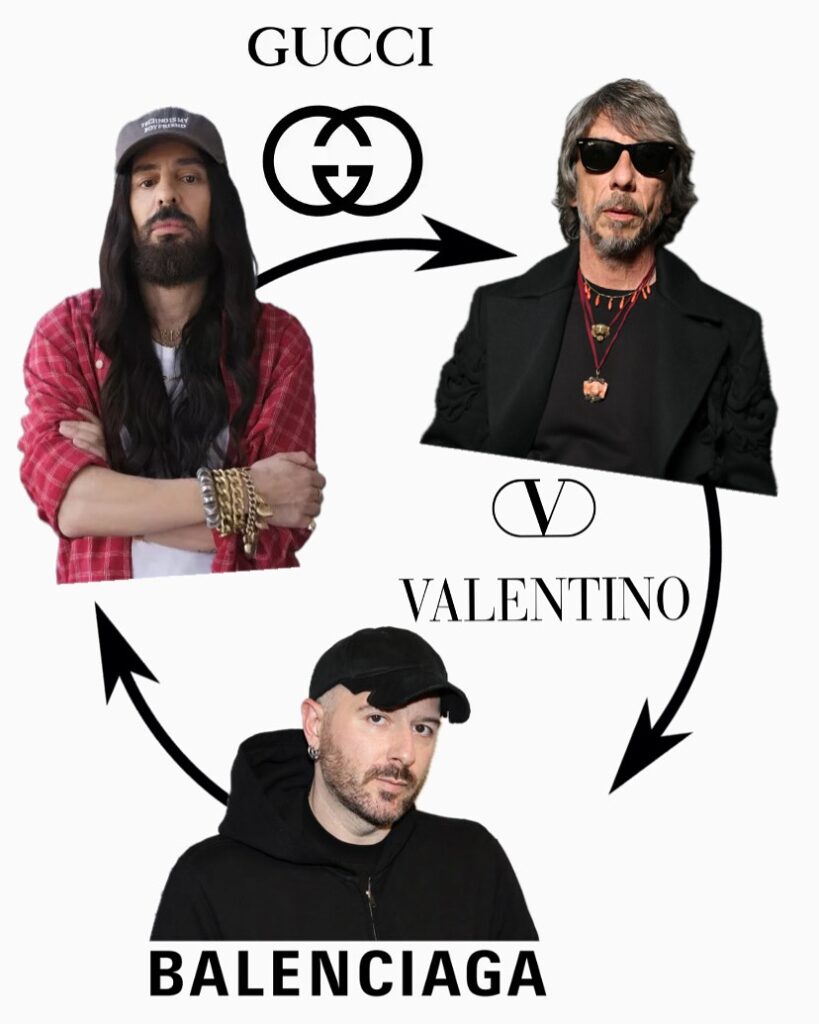
At Gucci, Sabato De Sarno left in February 2025 after two years, and a few weeks later the house had to show its Fall 2025 collection in Milan with the in-house team before naming Demna in March. At Versace, Donatella Versace stepped down in March 2025 after 28 years, Miu Miu’s Dario Vitale took over, and after the Prada Group bought the house, Vitale left in December following one collection, just like de Saint Sernin at Ann Demeulemeester. Pieter Mulier, who left Alaïa in January after five years, now runs Versace, and Vitale went to Armani in September to design Emporio Armani and the accessories.
Among the veterans, Hedi Slimane left Celine in October 2024 after more than six years and was replaced by Michael Rider, and Olivier Rousteing, who seemed untouchable, left Balmain in November 2025 after 14 years and this summer resurfaced at Rabanne, while Balmain hired Antonin Tron. At Moschino, after Jeremy Scott left in 2023, his successor Davide Renne died suddenly that November, weeks after being appointed, and Adrian Appiolaza, who took over in January 2024, left in June 2026. Even Jean Paul Gaultier, who spent years handing his runway to guest designers, settled on a permanent creative director, Duran Lantink, whose debut flooded the brand’s Instagram with angry comments.
By the Spring 2026 season everything seemed to fall into place, with 15 designer debuts in a single season. But reports already say Piccioli could leave Balenciaga after just over a year, and Nicolas Ghesquière, at Louis Vuitton for nearly 13 years, still faces recurring rumours about his exit.
By our count, at least 31 creative directors have left major houses since autumn 2021, nine of them in 2025 alone. The designers in that group who were appointed before 2020 had held their jobs for about ten years on average. The seven hired since 2022 who are already gone lasted less than two, from de Saint Sernin and Vitale with one collection each to McGirr’s three years. Back in 2023, WWD reported that creative director contracts had gone from about ten years to about three, renewable.
Among the few houses that kept their designers through all of this, Louis Vuitton has had Ghesquière since 2013, Hermès has had Nadège Vanhee on womenswear since 2014, and Prada has been co-led by Miuccia Prada and Raf Simons since 2020. Hermès menswear did change hands in 2025, when Véronique Nichanian, who had designed it since 1988, was succeeded by Grace Wales Bonner. Founder-run labels like Dolce & Gabbana, Rick Owens and Comme des Garçons haven’t had to deal with any of this at all.
The age of the mass market
Some of the designers who left the big houses moved to brands outside the usual luxury circle. Kim Jones became creative director of Areal, a new premium line from the Chinese down jacket giant Bosideng, and Sabato De Sarno joined the Shanghai label Icicle. John Galliano signed a two-year deal with Zara to rework pieces from the brand’s archive into seasonal collections, with the first one due in September. Zac Posen has led design at Gap since 2024, Clare Waight Keller joined Uniqlo the same year, and this summer Isaac Mizrahi returned to Target.
Collaborations between luxury designers and mass-market brands, like the ones H&M has been doing since Karl Lagerfeld in 2004, no longer bury a designer’s career the way a cheaper line buried Halston’s. In 1983 he signed a deal with JCPenney for a cheaper line, Bergdorf Goodman dropped his label, and he soon lost control of his own company.
What’s behind it?
Fashion has been one of the industries hit hardest by the economy. First came Covid, which shut down the lucrative Asian market and the rest of the world along with it, and in 2020 Bain counted a drop of about 23% in personal luxury goods sales. Wars and the political turn to the right did their part too, as the big luxury groups suspended their business in Russia in 2022 and the US imposed new tariffs on European goods in 2025. Bain expected spending in China to fall again in 2025, by 3 to 5%. The global economic crisis has pushed purchasing power down everywhere, and according to Bain-Altagamma, the number of luxury consumers in the world fell from about 400 million in 2022 to about 340 million in 2025.
Luxury also turned away from its aspirational buyers, and by following the quiet luxury trend and trying to serve the 1% of the 1%, brands lost many of the customers who brought in a big share of their profit. By the end of 2024, very important clients made up just over 2% of luxury customers and 45% of all purchases, up from 35% in 2021. “We are designing for rich people,” Miuccia Prada said backstage this year.
The new wave of tech bros in fashion hasn’t saved the business either. Karlie Kloss bought W in 2020 and i-D in 2023, and in 2024 she and her husband, investor Joshua Kushner, announced a relaunch of LIFE. Mark Zuckerberg and Priscilla Chan sat front row at Prada in February, and Jeff Bezos and Lauren Sánchez Bezos were the lead sponsors of this year’s Met Gala, which raised about $42 million. Meanwhile, sales of personal luxury goods fell from €369 billion in 2023 to €358 billion in 2025, and Saint Laurent’s revenue dropped from its peak of €3.3 billion to €2.6 billion last year.
Luxury also got astronomically more expensive, with prices of personal luxury goods in Europe up 52% between 2019 and early 2024, according to HSBC, and Chanel’s medium 2.55 flap bag up 91%, to €11,100. Even loyal clients who used to buy half a collection in good times had to tighten their belts, and greedy conglomerates got stuck in a trap, since lowering prices could turn into a huge reputational failure.
In the attention economy, if the fashion community doesn’t love you, and the brand’s loyal clients don’t either, from your very first season your days are numbered. “Everybody can become a critic,” Glenn Martens told CNN this year. A designer who makes four to eight collections a year gets one chance to make a statement at a house. In 2020, the investment firm Bernstein studied a dozen-plus creative director tenures at big luxury companies and found that profits kept growing for about four to five years before slowing down, calling five years “the ‘expiry date’ of successful creative directors,” and most of today’s designers don’t even get that far. As Mary Gallagher told WWD, “if a creative director is there less than three years, it sends a signal that the brand made a mistake.”
The bosses of the big conglomerates who started this reshuffle probably regret most of their decisions now, and they keep trying to fix them with the same illogical methods. Maybe it’s time for conglomerate owners to stop for a while and give designers a chance to show what they can do, since selling a collection and presenting it in the best light is the marketing department’s job anyway?