
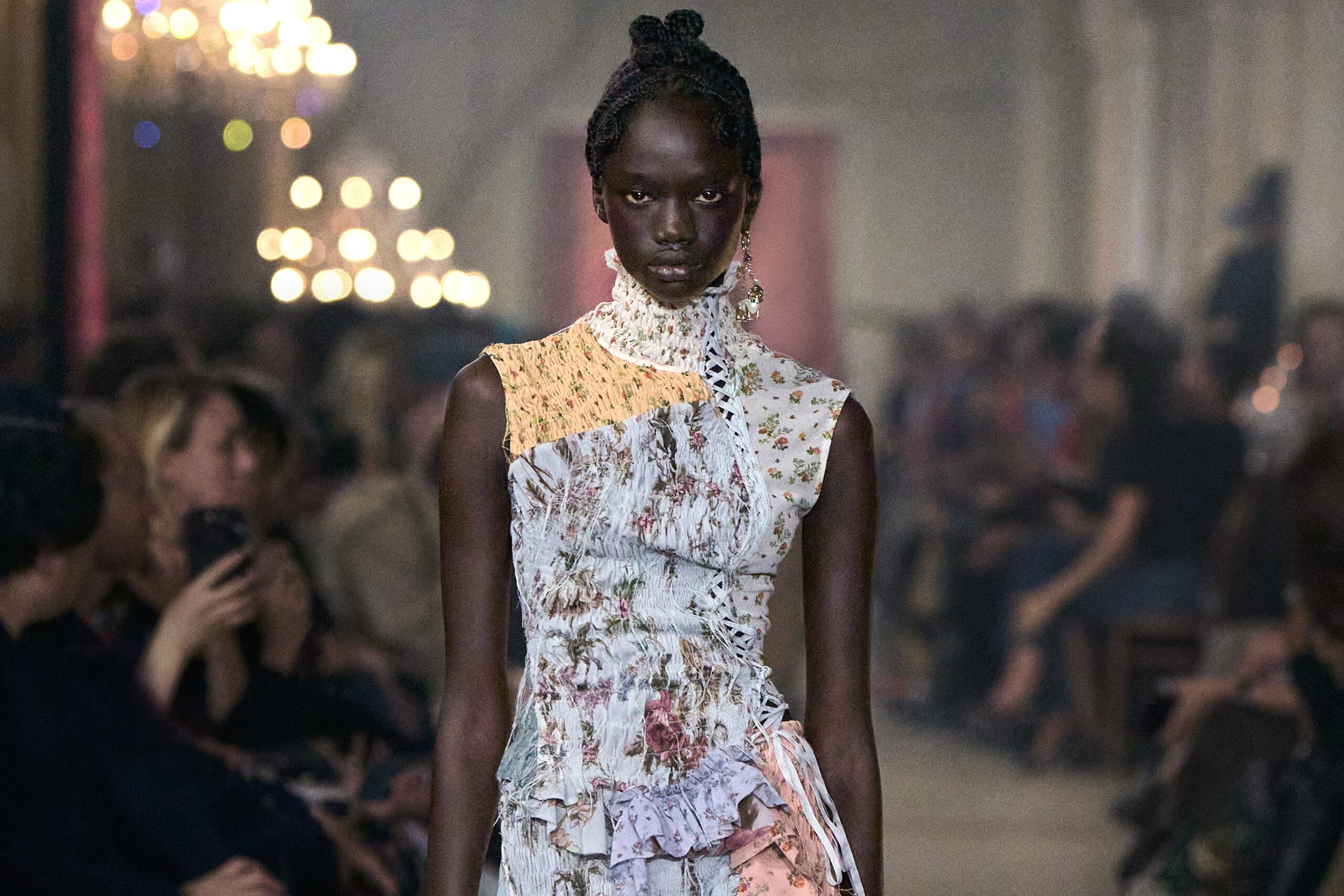
Acne Studios called its Spring/Summer 2027 womenswear show Denim Hystoria, built around pairing denim with historical dress that doesn’t belong next to it. Creative director Jonny Johansson framed the whole collection around that friction. “That tension has always inspired me,” he said. “Here, denim becomes a canvas that moves through time. The collection is fresh, salty and youthful, it is a study in modern theatricality while affirming something I believe to my core: that Acne Studios always likes to play, but we never want to pretend. For me, it has to be real.”
The set used traditional carpets by Faig Ahmed, an artist based in Baku known for reworking Azerbaijani carpet-making into sculptural and spatial work, staged so the carpets appeared to melt with the memories they once held. Ahmed has represented Azerbaijan at the Venice Biennale, and his work sits in collections including the Art Institute of Chicago and LACMA.
Technical taffeta tops were paired with twisted periwinkle and orchid miniskirts, worn with leather biker pants or plain jeans. A brocade skirt in faded fabric was worn with a polo knit. Full leather looks came treated to look aged, with a pea coat chopped and cropped, a morning coat finished with singed edges, and britches reworked into butter-yellow leather capris.
Denim itself carried the collection’s historical references directly. Pieces came printed with fragments of Renaissance paintings or lacquered with flowers, faded into porcelain-like blooms that read like painted ceramics. Smocked silhouettes with high collars echoed old master portraiture, while tailoring ranged from a full-length shimmering trench and a black redingote to pieces with their formal details pulled apart and reassembled.
The Camero bag returned in washed leather with a webbed strap, some versions finished with a buckle shaped like a Renaissance picture frame. Western boots stretched long with serpent intarsia patchwork, and square-toed mules came in metallic finishes for a more futuristic look. The soundtrack included an excerpt of Adam and the Ants’ “Prince Charming,” a loose nod to the New Romantic era referenced throughout the collection.
[imagely id=”3″]